
Turning Around a Spoiler Production Crisis During SOP Ramp-Up
by AJKA SOLUTION, WIL Group Member Czech Republic
How fast root-cause analysis and focused technical support cut a 54% scrap rate down to 5% in three weeks and rescued a Škoda Auto supplier’s start-of-production launch.
A Rocky Start of Production
During the Start of Production (SOP) ramp-up for a new painted spoiler line, a serious quality problem surfaced almost immediately. The critical step in the process was a robotic assembly station where the carrier and the spoiler were joined using structural adhesive, with hotmelt applied as a temporary fixation while the adhesive cured.
Shortly after SOP, Škoda Auto, the end customer, began flagging quality concerns coming out of that station:
- Part misalignment
- Visible, inconsistent gaps after assembly, audited as a B-level defect by the customer’s internal auditors
- Inconsistent assembly quality overall
At the supplier’s end, the same root cause was driving a rapidly climbing scrap rate and a growing production backlog, putting both on-time delivery and customer confidence at risk. The situation escalated to the point where production stoppages at the customer’s own assembly plants became a real possibility. To keep deliveries flowing, the supplier had to organize emergency shipments for close to two months, a costly, unplanned measure, while daily escalation calls between supplier and customer tracked the situation and coordinated immediate actions.
In parallel, operators on the line were manually reinforcing and stabilizing parts just to keep production moving. Every extra rework and assembly step the customer had to absorb on its side was later re-invoiced back to the supplier.
Finding the Real Problem
A detailed review of the robotic station and the part-positioning process showed that the bonding process itself, the initial suspect was not actually at fault. The true root cause was insufficient clamping and fixation of the parts inside the positioning fixture. That single weakness was producing three compounding effects:
- Part movement during processing
- Geometrical deviations
- Visually unacceptable defects
The supplier’s first response was manual part stabilization on the line. It bought some short-term
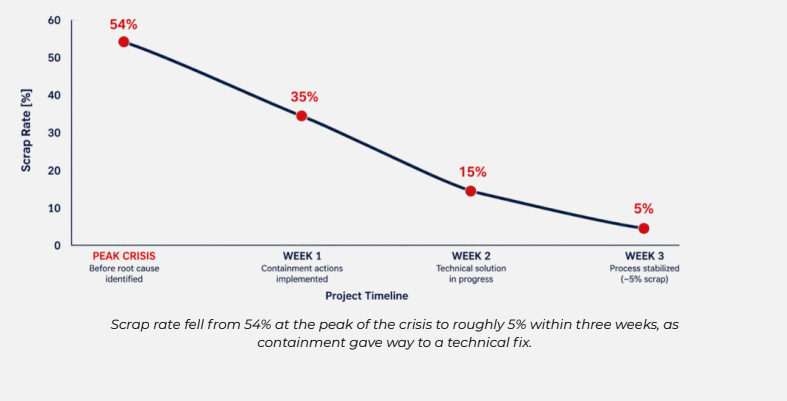
containment, but it came at a cost: more handling of already-painted parts, further growth in scrap, reduced process stability, and lower production capacity overall. At the peak of the crisis, the scrap rate reached 54%, an extraordinary burden on production, logistics, and the wider project.
Our Role and Approach
Once the analysis pointed to the fixture rather than the bonding process, the priority shifted from short-term containment to a durable technical fix. The core recommendations were to:
- Eliminate manual interventions that weren’t actually solving the problem
- Improve fixture design and process stabilization
- Focus corrective effort on automation and clamping-system improvements
- Escalate the issue to the fixture-tooling supplier and push for fast, problem-focused action on their side
- Secure investment for the necessary technical modifications
Alongside those recommendations, we stayed close to execution providing regular follow-up on corrective actions, technical support during implementation, and coordination between the supplier’s and customer’s teams. That combination kept decision-making fast and made sure corrective actions addressed the true source of the problem rather than its symptoms.
From Crisis to Stability, in Weeks
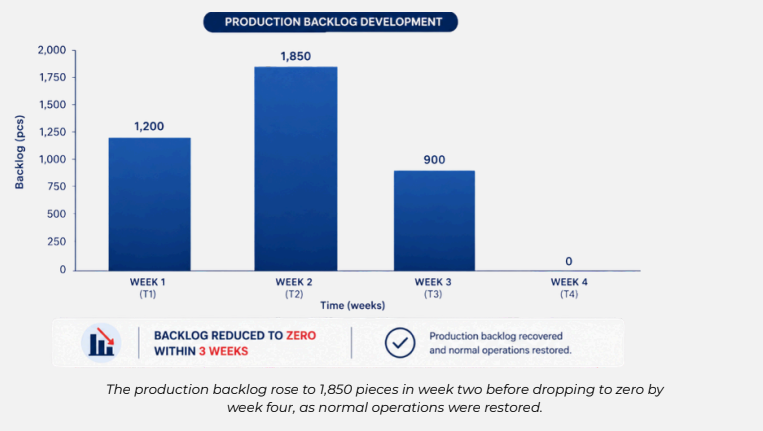
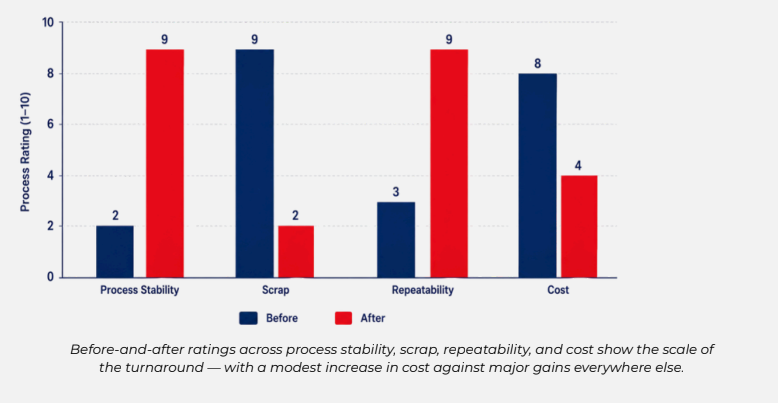
Within just a few weeks, the joint team turned the situation around. The process and product quality were stabilized back to the originally planned and sampled state, the key source of the quality issues was resolved, and the scrap rate came down from a critical 54% to approximately 5%. Emergency shipments were discontinued, the production backlog was brought down to zero, and the line returned to its planned stable state, including cycle time.
SCRAP RATE REDUCTION SURING SOP STABILIZATION
From critical situation to stable production within three weeks
PRODUCTION BACKLOG DEVELOPMENT
Backlog evolution during SOP stabilization
Production has since continued to run in a stable, sustainable mode without further complications.
SOLUTION COMPARISON
Before vs. After implementation
What the Project Delivered
Beyond the headline scrap-rate number, the project produced a set of measurable operational and financial benefits:
- Fast identification of the true root cause
- Prevention of long-term reliance on inefficient manual solutions
- Accelerated decision-making and implementation of corrective actions
- Stabilization of the SOP ramp-up phase
- Reduced impact on the customer
- Prevention of potential production disruptions at the customer’s assembly plants
- Elimination of extraordinary logistics and rework costs
- Significant reduction of quality-related losses
External technical support was a major factor in cutting resolution time and limiting the overall business impact.
Broader Areas of Expertise
The experience behind this turnaround spans a wide range of manufacturing technologies and
processes, including:
- Plastic injection molding
- Painted components
- Assembly operations
- Automotive electronics and infotainment systems
- Automated production lines
- Quality and logistics processes in the automotive industry
It’s the combination of an independent perspective, cross-functional manufacturing experience, and the ability to rapidly identify technical root causes that created value for both Škoda Auto and its supplier.
Conclusion
This project shows how rapid technical analysis, effective stakeholder coordination, and decisive action can stop a quality issue from turning into a major supply chain disruption. Within three weeks, a process running at a 54% scrap rate was stabilized to approximately 5%, allowing the supplier to restore normal production, eliminate emergency logistics measures, and secure customer deliveries.
By identifying the true root cause and supporting the implementation of the right corrective measures, production was stabilized, customer risk was minimized, and long-term process reliability was successfully restored.